Two-for-One in Texas, Illegal in Iowa: Mapping the State-by-State Patchwork of Drink Special Laws
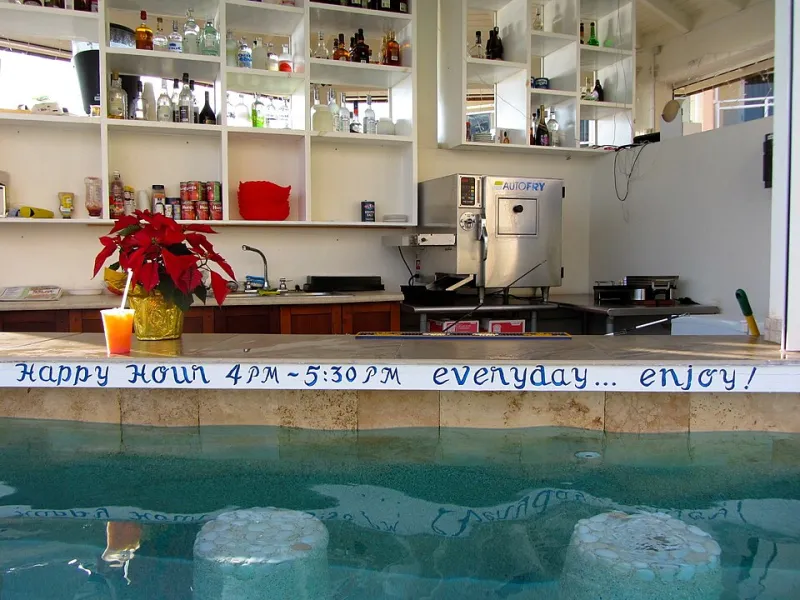
Photo: Richie Diesterheft from Santa Barbara, CA, USA, CC BY-SA 2.0, via Wikimedia Commons
A marketing team rolls out a national promotion: half-price craft cocktails from 4 to 6 p.m., free pitchers for tables of four, and a 'bottomless mimosa' brunch special. Within weeks, the Denver location is thriving, the Austin spot has set a sales record, and the Boston venue has received a notice of violation from the Massachusetts Alcoholic Beverages Control Commission. Nothing about the promotion changed. What changed was the state line.
This scenario plays out across the country with remarkable regularity, because the United States has no unified standard for alcohol promotions. Each state — and in some cases each municipality or county — writes its own rules about how drinks may be discounted, bundled, or given away. For operators with more than one location, or franchisees expanding into new markets, the happy hour is one of the most common and least understood sources of regulatory exposure.
Why Happy Hour Law Varies So Dramatically
The root of the patchwork is the post-Prohibition framework. When the 21st Amendment ended national Prohibition, it returned primary authority over alcohol to the states. The result is fifty-plus regulatory regimes, each reflecting its own political history, temperance legacy, and public health priorities.
Some states, like California and Texas, permit discounted drink pricing during defined hours but prohibit unlimited servings. Others, like Massachusetts, banned happy hour pricing outright in 1984 as a drunk-driving reduction measure and still prohibit it today. A handful of states allow nearly unrestricted promotion, while several — including Utah and parts of the South — impose additional restrictions tied to portion sizes, service methods, or food requirements.
The practical consequence: a promotion is not a marketing decision. It is a regulatory filing in disguise.
The Four Restrictions Most States Impose
While the details vary, state rules on drink specials tend to cluster around four prohibitions. Understanding these categories allows operators to vet any promotion quickly.
1. Unlimited or fixed-price consumption. Roughly half of states prohibit 'all you can drink' offers, bottomless cups, or flat-fee entry that includes unlimited alcohol. Some states define 'unlimited' broadly — a promotion with a generous but technically finite cap may still violate the spirit of the rule in jurisdictions like New York, which scrutinizes whether a consumer can reasonably obtain unlimited servings.
2. Time-of-day and day-of-week limits. Even where happy hours are legal, some states restrict when they may occur. Certain jurisdictions prohibit promotions after 9 or 10 p.m., or bar them entirely on designated holidays, out of concern for late-night impairment.
3. Free alcohol. Many states prohibit giving away alcohol outright, or permit it only under narrow conditions — with a meal purchase, up to a set quantity, or as a complimentary sample in a tasting context. A 'free drink with every entrée' promotion is lawful in some markets and a violation in others.
4. Drinking-contest and speed-based incentives. Promotions that reward rapid consumption — drink races, timed challenges, prizes for finishing a flight of shots — are prohibited in the majority of states and treated as aggravating factors in enforcement actions everywhere else.
The Multi-State Trap
For single-location operators, the fix is straightforward: learn your state's rules and follow them. The problem compounds for multi-unit operators and franchisors, where a corporate marketing calendar is typically deployed uniformly across markets.
Consider a regional chain with locations in Florida, Illinois, and Vermont. A 'buy one, get one free' cocktail promotion is generally permissible in Florida. Illinois prohibits free drinks but allows two-for-one pricing under specific conditions. Vermont's rules require careful structuring to avoid crossing into prohibited territory. A single national campaign, deployed without localization, creates simultaneous compliance exposure in three jurisdictions — with each violation attributed to the individual licensee, not the corporate office.
Enforcement bodies are increasingly attentive to these patterns. Penalty schedules in several states scale with the number of locations involved, and repeated identical violations across units can be characterized as a pattern of non-compliance that jeopardizes every license in the portfolio.
A Pre-Launch Vetting Framework
Operators can avoid most of this exposure by treating every promotion as a compliance review before it reaches the marketing calendar. A five-step framework:
Step 1: Classify the promotion. Is it a discount, a bundle, a giveaway, or an unlimited-serve offer? Each category triggers different rules in different states.
Step 2: Map every jurisdiction. For each location, identify the state (and local) authority and its current rules on that promotion category. Rules change; last year's guidance is not this year's law.
Step 3: Identify structural workarounds. Where a promotion is prohibited as designed, jurisdictions often permit a modified version — converting a bottomless offer into a capped two-drink special, or converting a free drink into a discounted one.
Step 4: Document the review. Keep a written record of the promotion's design, the legal review, and any jurisdiction-specific modifications. If a complaint or inspection follows, documentation of good-faith compliance is a meaningful mitigating factor.
Step 5: Train before launch. Servers and bartenders are the enforcement front line. A promotion the staff doesn't understand — or one they quietly 'improve' by over-pouring or waiving caps — converts a lawful special into a violation.
Marketing That Survives the State Line
None of this argues against promotion. Happy hours, brunch specials, and event pricing are legitimate and valuable tools. The argument is for localization: building a compliance checkpoint into the marketing workflow so that a campaign is reviewed market by market before launch, not reconstructed after a citation arrives.
Operators who build this discipline find that most promotions survive intact in most markets, with modest modifications at the edges. The cost of that review is a fraction of the cost of a single license suspension — and far less than the reputational cost of being the brand that ran an illegal drinking contest on the evening news.